
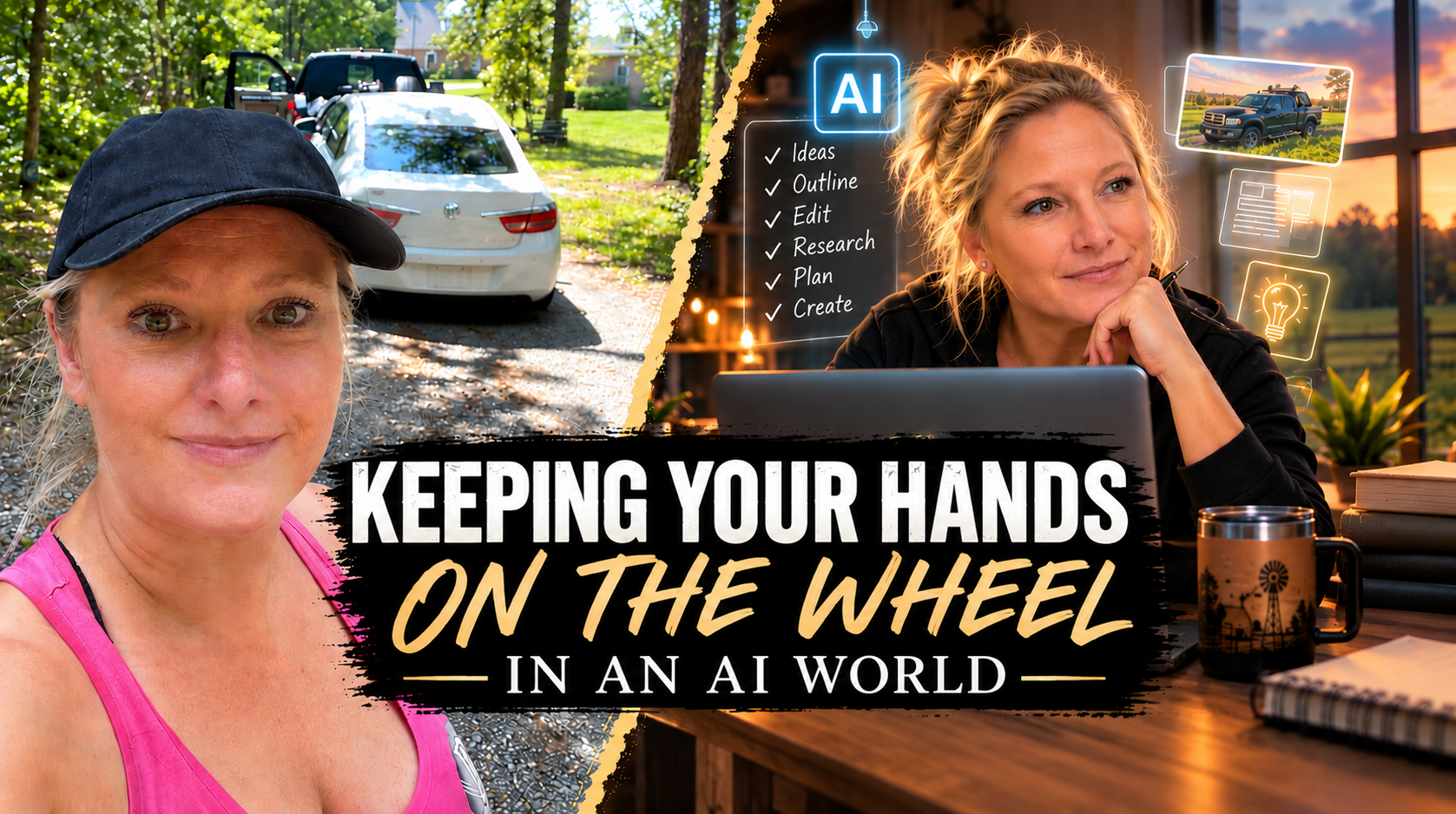
How I'm using AI to help build a small business, organize years of experience and create quiet income without letting technology replace the human life behind the work
I didn’t want to use AI. Honestly, I didn’t really like the thought of it.
When artificial intelligence started becoming something everyone was talking about, one of my first thoughts was:
How are we going to know what’s real anymore?
What’s somebody’s actual writing?
What’s their real photograph?
What’s their creativity?
And what’s something a computer created in a few seconds?
I worried about what that meant for people who had spent years learning how to write, photograph, design, create and build things from scratch.
It didn’t seem fair.
And if I’m being completely truthful, talking to a machine felt a little crazy to me too.
Some of that still makes me uncomfortable.
I still question AI and I still check things it tells me.
I still wonder where all of this eventually leads. But somewhere along the way, I realized something else:
Ignoring AI wasn’t going to make it go away.
And maybe understanding it would actually give me more control over the place I allowed it to have in my life and our business.
I Think I’ve Been Here Before
I fought social media too. I never particularly wanted to spend my life online posting everything I was doing.
And honestly? I still don’t.
But eventually I realized there was a difference between letting social media consume my time and learning how to use social media for something useful.
I could learn the platforms, understand what they did, use them to help our business and share something that might help another person. Then put the phone down and go live my life.
I’m starting to think about AI in much the same way. Maybe the question isn’t simply:
Is AI good or bad?
Maybe a better question is:
How much space am I willing to give it in my life?
Work can be good and still take too much from us.
Social media can connect people and still consume too much of our attention.
Money is necessary, but chasing more of it can consume a life.
Technology can make things easier without needing to become the center of everything.
It’s all about where we put things.
Maybe embracing AI doesn’t mean surrendering to it. Maybe it means learning enough about it to decide for ourselves what place we want it to have.
Why I Decided I Needed to Understand AI
Whether we personally choose to use AI or not, we’re increasingly going to encounter things created or changed with it like text, photographs, video and audio.
The National Institute of Standards and Technology has studied ways to improve transparency around synthetic content, including provenance information, watermarking and detection methods that may help people understand where digital material came from.
That matters to me.
I want to understand what I’m looking at and I want to question what I’m reading. And I want to understand enough that I get to decide what role this technology has in my life and our business.
Understanding something isn’t the same thing as agreeing with every way it can be used. Sometimes understanding it is what helps us become more discerning about it.
Then I Started Using It
I didn’t suddenly decide AI was wonderful. I started dabbling with it because I wanted to understand what everybody was talking about.
And something unexpected happened.
It helped me.
For years, I’ve written things down like journal entries, thoughts, business ideas, things I've learned, things I’ve struggled with and stories I didn’t want to forget.
Lessons from real estate, towing, running businesses, marriage, country life, faith, simply getting older and a lot of it was scattered everywhere.
Some was written down, some was sitting in computer files and some existed only in my head.
I started putting some of those thoughts into AI and discovered that it could help me organize what was already there.
That was different from what I imagined AI would be. I wasn’t asking a computer to give me a life or a story.
I already had those.
I was asking it to help me figure out what to do with them.
How I Actually Use AI in Our Small Business
Today, I sometimes think of AI as a virtual assistant, editor, researcher and thinking partner rolled into one.
I use it to help me:
- organize years of scattered writing and ideas
- edit things I’ve already written
- research and understand unfamiliar topics more efficiently
- learn software and online tools
- think through business decisions
- develop outlines for articles and guides
- turn lived experience into useful resources
- repurpose work I’ve already created instead of constantly starting over
- ask questions I might not have thought to ask myself
For someone running a small business, that can be significant. I don’t have unlimited money for consultants, assistants, designers, courses and education. I don’t have unlimited hours to teach myself every new program from the beginning either.
AI can often help me get far enough into something to understand what I actually need to learn next.
But there’s an important distinction.
Thinking for Me vs. Thinking With Me
There is a huge difference between asking:
“Write me an article about running a small business.”
and saying:
“Here’s what happened to us. Here’s what I’ve learned. Here’s what I’m struggling to explain. Here are the parts that matter to me. Help me organize this without turning it into something I wouldn’t say.”
The second approach still requires quite a bit from me like experience, judgement, memories, opinions, direction and the willingness to say no.
I can tell AI:
That doesn’t sound like me.
That’s too complicated.
That’s too salesy.
Go back.
What am I missing?
Help me understand this.
Sometimes it suggests something I hadn’t thought about and I love it. Sometimes I look at what it gives me and immediately think:
Nope.
That’s part of using it too. AI became much more useful to me when I stopped asking it to think instead of me and started asking it to think with me.
AI Can Help With the Navigation. I Still Want My Hands on the Wheel.
There’s another reason I don’t simply accept whatever AI gives me.
Generative AI can produce inaccurate information that sounds convincing. NIST refers to this risk as “confabulation.”
That matters when I’m researching towing requirements, business regulations, money or anything else where getting something wrong could actually affect somebody.
AI can help point me toward something I need to research. It can explain terminology. It can help me understand the question I should be asking, but when accuracy matters, I still need to go to reliable sources and verify the information.
AI can help me research. It doesn’t relieve me of the responsibility to care whether something is true.
That's probably the best way I know to describe my relationship with the technology:
AI can help with the navigation. But I still want my hands on the wheel.
What AI Helped Me Do and What It Didn’t
AI has helped me accomplish things faster, but there’s another side of that distinction that matters even more to me.
AI didn’t build our towing business. It didn’t run the trucks or teach me how to back a trailer.
AI didn't work all those years in real estate, make our financial mistakes, live through a failed business, rebuild with us, build our marriage, buy our land, walk to the mailbox, learn the lessons, decide what I believe or determine what matters to me.
We had to live those things.
That's the part I don't want technology to replace. Because if I'm going to turn something I've learned into an article, guide, video or resource that might help somebody else, the value still has to come from somewhere.
Turning Experience Into Something Useful
One example is a guide I recently created called We Didn’t Build a Business Just to Work All the Time.
AI didn’t teach me that lesson.
Life did.
Wayne and I have spent years building businesses, working too much, making mistakes, rebuilding, trying to make enough money and eventually realizing that freedom doesn’t automatically arrive just because your business becomes successful.
I had already lived it. Thought about it. Written about it.
AI helped me take those experiences and ask:
What’s actually useful here for somebody else?
What have we learned about enough?
What could be simplified?
What should be protected?
How could somebody take these ideas and actually do something with them?
Eventually those conversations became a guide. The experience was human. The organization was AI-assisted. The decisions were mine.
That’s the kind of AI use I’m interested in.
AI and the Quiet Income I’m Building
This has also become part of something else I’m working toward. I've started using the phrase quiet income to describe it:
Income that doesn’t require every good hour of my life.
I don't mean get-rich-quick income and I don't mean pretending anything that makes money online is magically passive. And I definitely don't mean using AI to churn out hundreds of meaningless products just because we can.
I mean taking something I've actually learned and turning it into something useful like a guide, an article, a resource, a recommendation or something that can continue helping another person while Wayne and I are running trucks, working around the property or simply living our life.
I'm currently working on another resource around building a simple online home for your business.
Once again, AI isn't teaching me that from some life it has lived.
I'm actually building the website.
I've paid for things, tried apps, removed apps, changed menus, created products, built email automations, made things too complicated and simplified them again. And slowly figured out what I actually need versus what somebody online tells me I need.
AI can help me organize those experiences into something another small-business owner may eventually be able to use.
That's where I think technology can be especially valuable for people like me.
Not replacing the experience.
Helping us do something useful with the experience we've already earned.
The Line I’m Trying to Draw
I don't have a universal set of AI rules for everyone.
I'm still figuring out my own.
But these are becoming some of them:
AI can help organize my story. It shouldn’t invent my story.
AI can help improve my words. It shouldn’t decide what I believe.
AI can help me research. I still need to care whether something is true.
AI can help me create faster. Faster doesn’t always mean better.
AI can help create images. That doesn’t mean real photographs need replacing.
AI can suggest what I could build or sell. I decide what’s actually worth creating.
AI can help with my work. I don’t want it replacing the parts of life I’m trying to make more room for.
The U.S. Copyright Office has made an interesting distinction here too. Its guidance recognizes that AI can assist human creativity without automatically preventing copyright protection, while purely AI-generated material without sufficient human authorship is treated differently.
That distinction makes sense to me beyond copyright law:
The tool can participate in the process without having to become the author of your life.
Keeping Real Life in Axles & Acres
Images are probably the place I’ve struggled with AI the most.
AI imagery is fascinating. You can have something in your head, describe it and suddenly see a version of your imagination sitting in front of you.
I’ve used AI imagery while building Axles & Acres. Some of it I really like. And some of it I look at now and think:
That’s probably a little more AI than I want this to feel.
I'm okay admitting that. I'm learning and the clearer Axles & Acres becomes to me, the more I want our real photographs to show it.
Our trucks, our property, our house, the dogs, Wayne, Me, the imperfect driveway, and the things we're actually doing.
There may still be times when an AI-created image helps me communicate an idea, but I don't want artificial imagery replacing our real life.
If you spend time here, I want you to know there are actual people behind it.
If You Feel Behind, Start With What You Actually Need
One of the easiest things to do with technology is convince ourselves we need to learn everything.
We don't. You don't have to understand everything AI can do. You don't need every platform or every new program. And you don't have to become an AI expert.
I'm finding it much more useful to ask:
What do I actually want to do?
Then:
What do I actually need to learn to do that?
Learn one thing, use it, then learn the next thing when you actually need it.
I've wasted plenty of time learning about things that had absolutely nothing to do with what I was trying to build. I'm trying not to do that anymore.
What Do I Actually Want AI to Give Me?
This may be the most important question I've asked myself about any of this.
Not:
How much money can AI help me make?
Not:
How much content can I produce?
Not:
How many things can I automate?
If technology could ultimately give something back to me, what would I actually want?
My answer was pretty simple.
Time.
More time with my family. More time working on our house. More time outside. More time taking care of myself. Less mental clutter. More time to write. More time to create. More quiet ways to help people who might only be a few steps behind me. More freedom. More independence. And more ability to do work I enjoy in a way that fits naturally into the life we're trying to build.
Maybe that's how I'll know whether I'm using AI well:
Is it helping me live more of my life or just giving me another reason to spend it staring at a screen?
Still Me
At the end of the day, I’m still Brenda. Wayne and I are still running trucks. There are still vehicles to move. The driveway still needs work. The grass still grows. The house always has something that needs doing. The dogs still want attention. There are bills to pay. People to love. Things to fix. Walks to take.
And an entire life outside this computer that I don't want to miss.
I don't know exactly where AI is going.
There are parts of it that still concern me. There are questions about creativity, authenticity, copyright and what all of this eventually means that I certainly don't have the answers to.
And I'm sure I'll draw some of my boundaries differently a year from now than I do today. But I don't want fear to make all those decisions for me either.
I want to understand what's happening around me. Keep learning. Keep questioning. Keep creating. And keep my hands on the wheel.
Because I’m not learning AI because I want more technology in my life. I’m learning how to use technology because I want more life in my life.
If it can help me spend a little less time trying to organize everything inside my head, turn some of the experience I've already earned into something useful and build income that doesn't require every good hour of my life—
then maybe that's exactly where it belongs.
Not replacing my life.
Helping me make more room for it.
— Brenda
Axles & Acres
Built from Durrett Recovery
Build the work. Live the life. Remember what matters.
A Note About How This Article Was Made
This article is also an example of what I've been talking about.
The experiences, opinions, stories, concerns and answers in it are mine. I spent time answering questions about my relationship with AI—what concerned me, where it has helped, where I think it can go too far and what I actually want from it.
Then I worked with AI to help organize those thoughts, research factual pieces I wanted to verify, shape the structure and edit them into the article you just read.
And then I reviewed it as me. Because that's the relationship I'm trying to build with this technology:
Human experience first.
Technology in the supporting role.
Human judgment at the end.
Maybe that's one way we keep our hands on the wheel.
More From A Place for Beacons
This is part of A Place for Beacons, where I share what I'm learning about building quiet income, working from home and creating more freedom without letting work consume the life it's supposed to support.
Read more from A Place for Beacons →
Brenda’s Beacons
Some of the little lights I find along the way are simply tools, books and resources that have genuinely helped me.
I keep a collection of the things I use and recommend—including tools that have helped me build quiet income, work from home and simplify the way I work.
As an Amazon Associate, I may earn from qualifying purchases at no additional cost to you.


