
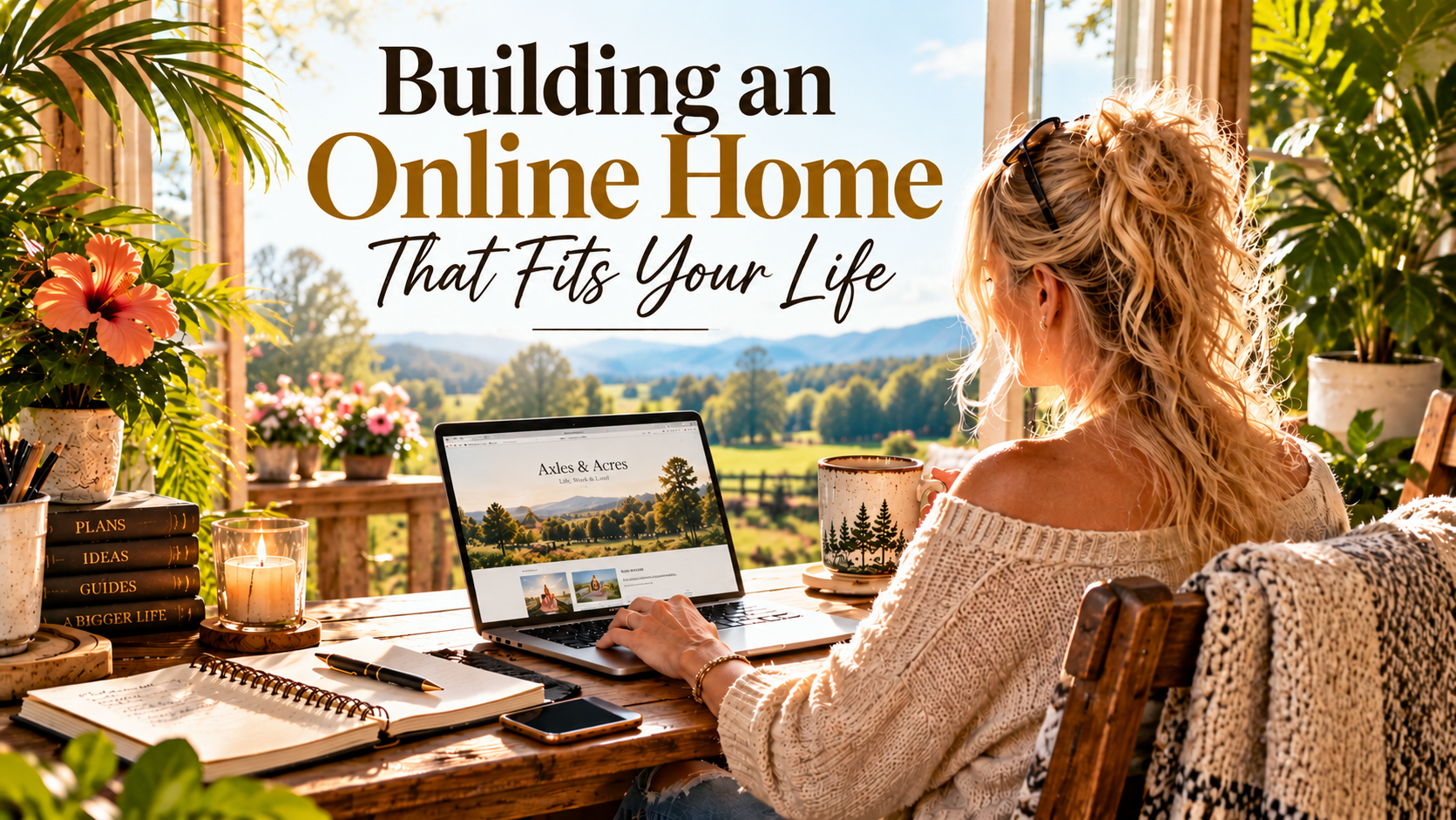
It took me a long time to realize I didn't need more ideas. I needed a place for the right ones to go.
There are a lot of ways to build something online.
I know because at one time or another, I think I've looked into most of them: blogging, affiliate marketing, dropshipping, digital products, print-on-demand, YouTube, social media, courses, different website platforms, different email programs and probably a few things I've already forgotten about.
The problem was never that I couldn't find enough possibilities. I had too many of them.
And if you're anything like me, more possibilities don't always make things clearer. Sometimes they just give you more furniture to move around:)
I Spent a Long Time Asking the Wrong Question
For a long time, I would find something somebody else was doing online and think, Could I do that?
Most of the time, the answer was probably yes. I could learn it, figure out the software, open another account and watch enough videos to understand how somebody else was making it work.
But eventually I realized “Could I do this?” wasn't really the question I needed to be asking.
The better questions were:
-
What do I actually want to do?
-
How much time do I really have to give it?
-
What can I realistically build within that time?
-
What do I NOT want this business to require from me?
That last question changed quite a bit for me.
Because we're not just choosing ways to make money. We're choosing work we're going to have to live with.
Just Because Something Works Doesn't Mean It Fits You
I'm fairly introverted. Not because I don't like people, I've just always been somewhat shy and socially awkward, and social situations can take a lot out of me.
So building something that required me to constantly be in front of people didn't make a whole lot of sense.
I knew I wanted to do most of my work behind the scenes and largely from home. I wanted to be able to be on camera when it made sense, without building something that depended on me being on camera every day.
I wanted to teach, share what I've learned and help people, but I wanted to find a way of doing those things that actually fit me.
That helped me start ruling some things in and some things out.
I Started Paying Attention to the Work I Actually Like Doing
I love to write.
I've wanted to write for a long time, but for many years there was always work, home, kids and everyday life competing for the time it would take to figure out how to really do something with it.
So writing needed to be part of whatever I built.
I also like software. I'm one of those people who can sit down with a new program and usually figure out fairly quickly whether it's going to work for me. Once I've already spent the time learning something, I enjoy being able to turn around and make it a little easier for somebody else.
That's one reason affiliate marketing started making sense to me.
I was already researching products, programs and software, deciding what worked for us and what didn't. If something genuinely helped me, I could write about it, explain why I use it and point somebody else toward it.
Writing and affiliate marketing naturally fit together for me.
Then There Were Digital Products
I've used Microsoft programs and created documents, forms and spreadsheets throughout my working life, so the idea of digital products made sense to me too.
If I created a checklist because we needed it in our business, maybe it could save somebody else some time. If Wayne and I had spent years learning something about towing and auto transport, maybe I could organize some of that experience into a guide for someone just getting started.
I liked the idea that I could do the work once, put it somewhere useful, and let somebody find it when they needed it.
That fit me much better than creating another business where every dollar required another appointment on my calendar.
I Even Wanted a Few Actual Products, Just Not a House Full of Boxes
I also liked the thought of creating something physical: a mug, a shirt, a piece of wall art, something meaningful from one of our photographs or something we've learned along the way.
What I didn't particularly want was another job packing boxes, storing inventory and making trips to ship orders.
That's where print-on-demand made sense for me.
I could enjoy the part I liked, coming up with and designing something, without necessarily taking on all the parts I didn't want my days built around.
Again, there isn't anything wrong with running a traditional product business. It just wasn't the life I was trying to build.
And I think that's an important distinction.
Then I Realized I Was Already Standing on a Business
For a while, I also thought I might need to create something completely separate from Durrett Recovery. Something new, an “online business.”
But the more I thought about it, the less sense that made.
We had already spent years building a real business. There was experience and credibility behind it, and we were doing the work every day.
We already had:
-
questions people asked us;
-
equipment we used;
-
software we'd learned;
-
mistakes we'd made;
-
things we wished we'd known when we started;
-
forms and systems I'd created because we needed them ourselves;
-
stories from the road; and
-
lessons from running a business together.
Why would I pretend none of that existed just because I wanted to build something online?
I didn't necessarily need to create a completely separate business.
I could build from the one we already had.
That eventually became a big part of what Axles & Acres is.
The Platform Wasn't Actually the First Decision
This is probably the biggest thing I wish I had understood earlier.
It's easy to start by asking whether you should use Shopify or WordPress, whether you need a Stan Store, whether you should start on social media or whether you even need a blog.
Those aren't bad questions. They're just not the first questions.
The first question is:
What am I actually trying to build?
Once I had a better answer to that, I could finally see what I needed the technology to do.
I wanted one online home that could:
-
hold our existing service business;
-
give me somewhere to write;
-
let me create and sell digital products;
-
give us the option for a few physical and print-on-demand products;
-
hold helpful resources and affiliate recommendations;
-
help us build an email list; and
-
leave room for all of it to grow without needing a completely different home every time I had another good idea.
For me, Shopify eventually became that foundation.
Not because I think everybody needs Shopify. It simply fit what I had finally figured out I wanted to build.
If you'd like to build something of your own on Shopify, start here: SHOPIFY
Shopify Gave My Ideas Somewhere to Go
This may actually be one of my favorite things about having our website now.
My mind doesn't exactly have a shortage of ideas. 😂 Before, those ideas could feel scattered. Now they have places to go.
Something we learn from towing can become a Life on the Axles article or guide. Something from working at home or living out here can become part of Life on the Acres. A lesson from life, faith, marriage or something I've been thinking through might find its way into A Place for Beacons.
A product might become a review or helpful resource. Something I've created to solve one of our own problems might become a digital download, and a larger idea might eventually become a book.
Some ideas aren't ready for anything yet. They can sit in my idea bank until they are.
I don't have to build every thought the minute I have it. But now I have somewhere for the right ones to go.
You Don't Have to Become a Technology Expert
I think this matters especially for those of us who didn't grow up with all of this.
Maybe you're in your 40s, 50s, 60s or beyond. You might have thirty years of work experience and still have no idea what somebody means when they start talking about funnels, integrations, automations, SEO and algorithms.
That doesn't mean you don't have something worth building, and it doesn't mean you need to spend the next two years learning every piece of technology before you're allowed to begin.
You need to learn the next thing you actually need.
That's different.
You don't need every app, social platform or income stream. You don't need the perfect website, and you definitely don't need to know what your business will look like five years from now.
You need a place to start.
Start With the Life, Not the Internet
If I were starting over today, I wouldn't begin by researching website platforms.
I'd get out a piece of paper and answer four questions:
-
What do I actually want to do?
-
How much time do I really have to give it?
-
What can I realistically build within that time?
-
What do I NOT want this business to require from me?
Then I'd look at what I already have:
-
What do I know?
-
What have I spent years learning?
-
What do people ask me about?
-
What have I already created because I needed it?
-
What do I enjoy?
-
What kind of work fits my personality?
-
What kind of life am I actually trying to build around this work?
Only then would I start choosing the technology.
Because the technology is supposed to support the business. The business isn't supposed to be built around the technology.
Build the Smallest Version That Works
I also wouldn't try to build the finished version anymore.
I'd build the smallest useful version: a home, an About page, a place explaining what I do, a way to contact me, a way for someone to receive more from me if they want it, and one useful thing.
Then I'd start creating.
Not another month of setting up, another complete redesign or another platform because somebody on YouTube said it was better.
I'd put something useful into the home I'd already built, then another and another.
Eventually, you have more than a website.
You have a library.
That's What I'm Trying to Build Now
I'm not trying to feed every platform every day.
I'm trying to build useful things that have somewhere permanent to live: articles, guides, videos, books, reviews and resources, along with things we've learned from running a business and building a life around it.
Things that might make somebody else's road a little easier.
Then social media, Pinterest, YouTube, email and the other places we use can simply become roads leading people back to that work.
That's a much simpler way for me to think about all of this.
And maybe that's the thing I was trying to find all along.
Not another online business idea.
A home for the things I already had in me to build.
If You're Trying to Build Something of Your Own
I've taken what I've learned from the longer road around and put it into a new guide called Build Your Online Home.
It's for the person who knows they want to build something online but isn't sure what that something should be, which pieces actually fit them or where any of it should live, especially if technology isn't second nature to you.
We start before the website, with your life, your time, your experience, the kind of work you actually enjoy and the things you don't want another business to require from you.
Then we work through the different ways you might build, what you already have to build from, how to choose an online home, what you really need to get started and a simple first 30 days.
Not everything you could build.
Just enough to help you figure out what makes sense for you to build.
Explore Build Your Online Home →
And if you're not ready for the guide but want to see the actual tools, software and systems I'm using as I continue building ours, I've also been gathering those in Behind the Scenes.
Maybe you don't need another idea. Maybe you already have plenty of those.
Maybe you just need to decide which ones deserve some of your life and finally give them somewhere to go.
You can learn the next thing when you need the next thing.
Keep going. 🌾
— Brenda
Keep Building From Here
If you're trying to figure out how to build something online that fits your life, I've put together a few resources that might help you along the way.
Build Your Online Home A practical guide to help you sort through your ideas, decide what fits your time and experience, choose where to build, and take those first steps without getting overwhelmed.
Go Behind the Scenes Want to see the actual tools, software and resources I'm using as I continue building ours? I'm sharing those along the way, including what's working and what I'm learning.
The Axles & Acres Dispatch Our weekly newsletter with stories from the road and land, helpful resources, things we're learning and what's happening around Axles & Acres.


