
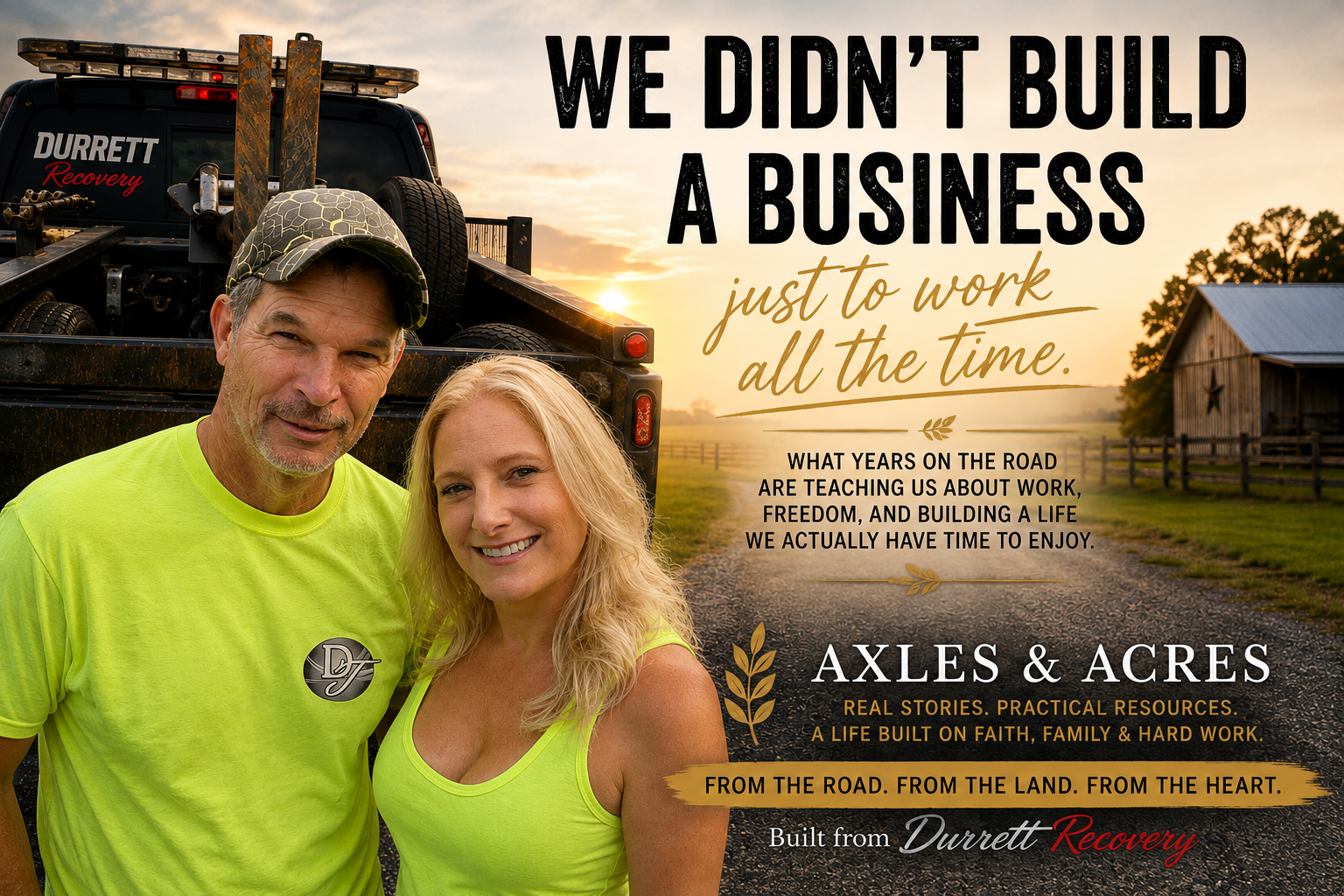
5 lessons I've learned about building a business that supports your life instead of consuming it
We didn't build a business just to work all the time. I've said that sentence before, but it took me a long time to understand what it really meant. Owning a business can give you freedom. It can give you independence. It can give you choices a traditional job may not. But I've also learned that owning a business can quietly take every bit of that freedom back if you let it.
There is always something else that can be done. Another customer. Another email. Another problem. Another idea. Another way to grow. Another hour you could work.
After decades around small business, including more than a decade of building and running our towing and transport company together, I know what it takes to work hard and build something.
I also know what it feels like when the business starts taking too much. And those experiences have taught me something I wish I had understood much earlier:
Building a successful business and building a business that supports a good life are not necessarily the same thing.
You have to intentionally build for both. I still have things I'm figuring out, especially as I build this next part of our business through Axles & Acres. But I'm not starting from scratch. There are lessons I've already earned. Some of them the hard way. And one of the biggest is this:
The answer isn't simply learning how to work fewer hours. It's learning what deserves your hours in the first place.
For me, that starts with God. I've had to learn that not every opportunity is mine to pursue. Not every problem is mine to solve today. Not every idea needs to become something.
Proverbs 3:5–6 reminds me to trust in the Lord instead of depending entirely on my own understanding, to submit my path to Him and trust Him to make it straight.
That doesn't mean I don't plan. It doesn't mean I don't work hard. It means I don't have to carry every possible version of the future while I'm trying to live today. My responsibility is to faithfully take care of what is mine to do.
Knowing what isn't mine to carry has become just as important.
If You're Trying to Build This Kind of Business Too
These are some of the lessons behind my guide, We Didn't Build a Business Just to Work All the Time.
I created it for small business owners who want their business to succeed without allowing it to consume the life they're working so hard to build.
The guide goes deeper into deciding what deserves your time, what "enough" looks like, what you can simplify or stop doing, what work can keep creating value after you've finished it—and what your business is supposed to provide and protect.
1. Decide What Your Business Is Supposed to Provide—and Protect
Most business advice asks some version of:
What do you want your business to earn?
That's an important question. We need revenue. We need profit. We need customers. A business has to make money if we expect it to remain a business. But after years of doing this, I believe there's another question that's just as important:
What is your business supposed to protect?
Your marriage? Your health? Your home? Your faith? Time with your family? A slower pace? The ability to travel? Time for hobbies? An afternoon outside? Your peace?
For us, one of the reasons for owning a business has always been independence. And our business has given us freedoms I'm very grateful for. But freedom creates an interesting problem of its own.
You can spend years building freedom and still have to learn how to live it.
If every bit of freedom you create gets filled back up with more work, eventually you have to ask what all that freedom was for.
Jesus asks a much bigger question in Mark 8:36:
"What good is it for someone to gain the whole world, yet forfeit their soul?" — Mark 8:36, NIV
I don't believe there's anything wrong with wanting a successful business. I want ours to be successful. I want Axles & Acres to make money. I want the work I create to reach people. I want our income to grow.
Wanting a profitable business and wanting a peaceful life are not opposing goals.
But if we never define what our businesses are supposed to give us—and what they're supposed to protect—the business can eventually become the life. So I've learned to ask myself:
What kind of life is this business supposed to help us live?
And then:
What parts of that life am I no longer willing to sacrifice just to make the business bigger?
Those answers should influence the way we build.
2. Learn the Difference Between Faithful Work and Endless Work
I believe in hard work. I've worked hard most of my life, and I don't believe the answer to burnout is pretending hard work doesn't matter. Scripture doesn't teach that either.
Colossians 3:23 tells us:
"Whatever you do, work at it with all your heart, as working for the Lord, not for human masters." — Colossians 3:23, NIV
That verse has become important to me because faithful work and endless work are not the same thing.
There will always be more I could do. I could make another post. Start another product. Try another platform. Answer another email. Change something else on the website. Research another idea. Work another hour. But more work does not automatically mean better work. And more work doesn't automatically mean I'm being more responsible.
One of the most useful questions I've learned to ask myself is:
Am I still working because this is today's responsibility—or because I'm afraid of what will happen if I stop?
Sometimes the answer is that I genuinely need to keep working. There are seasons when business requires more from us. I've lived those too. But sometimes I'm no longer working from responsibility. I'm working from fear. Fear that I'm falling behind. Fear that somebody else is doing more. Fear that something won't work if I don't keep pushing. Fear that I should have figured all of this out already.
That's where I've had to learn the difference between responsibility and control. I can make good decisions. I can work hard. I can prepare. I can follow through. I can manage money responsibly. I can correct mistakes. But I cannot guarantee every outcome.
Philippians 4:6–7 reminds me not to live in anxiety about everything, but to bring those things to God in prayer.
For me, the process has become simpler:
Do what is mine to do. Bring what I cannot control to God. Remember what He has already done. Trust Him with the outcome. Keep going.
I've learned that surrender and discipline are not opposites. You need both. Some things need my action. Some things need my surrender.
Wisdom is learning the difference.
3. Build Things That Can Keep Working After You Stop
This has become one of the most important principles I'm using as I build the next part of our business. For years, much of our income has depended on work happening again tomorrow. Another vehicle. Another trip. Another day. Another job.
That's how service businesses work, and there's nothing wrong with it. Our towing and transport business has served us well. But service businesses also taught me something:
If every dollar requires another hour of your life, eventually time becomes the ceiling.
So now I'm asking a different question:
Can some of the work I do today continue creating value tomorrow?
That's one reason I'm writing. It's why I'm building a library here on our website. It's why I'm interested in useful, searchable YouTube videos instead of constantly creating something just to feed social media. It's why we've turned some of the lessons we've learned in business into guides. It's why I'm writing books. And it's why affiliate resources make sense to me when they're connected to products, equipment, books or software we genuinely use, believe in or have a good reason to recommend.
One useful article can help someone years from now. One good video can continue being found. One book can help people I've never met. One useful guide can answer a question without requiring an appointment with me. One honest recommendation can keep solving the same problem. That's different from simply creating more content.
I'm building assets.
And that's an important distinction. I'm willing to spend ten hours creating something worthwhile if those ten hours can continue creating value long after I've finished the work. That's a much better use of my time than spending ten hours every week creating things that disappear almost as quickly as I publish them.
The goal isn't to avoid work. The goal is to make the work worth something beyond the hour I spent doing it.
I've spent years building freedom. I'm not interested in filling all of that freedom with more work. I want to build work that helps protect it.
How We're Building Differently
Axles & Acres has become a place for us to turn what we've learned through years of business, towing, country life, mistakes, rebuilding and ordinary life into resources that can continue helping somebody else.
→ Guides & Downloads
Practical resources we've created from lessons we've actually learned.
→ Behind the Scenes
The tools, software and resources we use to run our business, website and Axles & Acres.
→ Helpful Resources
Towing equipment, business resources, acreage finds and other things we've found useful along the way.
4. Decide What Doesn't Deserve Your Time Anymore
This is where simplifying becomes harder. It's easy to say you want a simpler business. It's much harder to stop doing things. Every platform can sound important. Every idea can have potential. Every product might sell. Every opportunity might become something. But there is a cost to keeping all of them.
Your time.
Ecclesiastes 3:1 tells us:
"There is a time for everything, and a season for every activity under the heavens." — Ecclesiastes 3:1, NIV
I've had to learn that this applies to business too. A good idea can still be the wrong idea for this season. And not now doesn't have to mean never.
Sometimes saying no to one good thing creates enough room to do the right thing well. Right now, I'd rather create one meaningful YouTube video than five pieces of content because somebody says that's what an algorithm wants.
I'd rather write an article that can help someone three years from now than spend hours trying to keep every social platform active today. I'd rather have a few genuinely useful products than a store full of things I created just to have something to sell. I'd rather take the time to write a good book than rush out another product because I feel pressure to monetize faster.
That's not giving up on growth.
It's being more selective about what kind of growth I'm willing to spend my life building.
I've also had to learn that planning for tomorrow doesn't mean I have to mentally live there. My mind can get months—or years—ahead of my actual life.
What if this happens?
What if that doesn't work?
Where will the business be next year?
What should I build next?
How will I make this profitable?
What if I choose the wrong thing?
Planning is responsible.
Preparing is responsible.
But trying to mentally solve every possible version of the future is not the same thing as planning.
Matthew 6:34 reminds us not to worry about tomorrow because tomorrow will have concerns of its own.
I've come to love the simplicity of that. Tomorrow is allowed to stay tomorrow.
I can make a plan without mentally living there. I can prepare without obsessing. I can work toward a goal without requiring myself to know exactly how the entire thing will turn out.
Do today's work today.
Tomorrow will get its turn.
5. Your Life Can't Always Get What's Left
I've learned this one the hard way. Your business will take as much as you're willing to give it. There will always be another task. That's why waiting until the work is finished before living the rest of your life doesn't work.
The work is never completely finished.
I don't want my marriage to get whatever is left after business. I don't want our home to become nothing more than the place where I work. I don't want hobbies to remain things I'll get around to someday. I don't want taking care of myself to automatically feel selfish. I don't want prayer to be the thing I finally turn to after I've exhausted every solution I could think of myself. And I don't want to work hard to create freedom only to spend that freedom worrying about how to create more.
Ecclesiastes 3:13 talks about enjoying the results of our work as a gift from God.
I've needed that reminder.
Enjoying the fruits of your labor is not the opposite of being responsible.
There is a time to work hard. And there is a time to close the computer. Go outside. Sit with your husband. Plant something. Pick up the guitar. Walk around the property. Take care of yourself. Enjoy your home.
Live there.
Don't spend years building a life and then make yourself feel guilty for actually living it. That sounds simple. For me, it hasn't always been. There is almost always something productive I could be doing. But I'm learning to question what productive really means.
Sometimes productivity is finishing an important project. Sometimes it's making the phone call I've been putting off. Sometimes it's handling the paperwork. Sometimes it's getting a vehicle delivered. Sometimes it's writing something I believe can help someone. And sometimes the responsible thing is shutting the computer, walking outside and participating in the life all that work was supposed to help create.
What I'm Building Differently Now
I don't want any of this to remain a nice idea. I'm actually changing the way I build. Axles & Acres is part of that. It's a place where I can take what we've learned through years of business, work, mistakes, rebuilding, marriage, country life and faith and turn those lessons into something useful for someone else.
But I'm intentionally building this part differently. Not around constant output. Not around being on every platform. Not around chasing every new idea. And not around needing more of my personal time every single time the business earns money or helps someone.
I want to build things carefully. Books. Guides. Articles. Videos. Useful resources. Recommendations I actually believe in. Things that can continue helping someone when I'm not sitting at my computer.
I know that kind of business won't happen overnight. And there are no guarantees that every book, video, article or product I create will succeed.
But I do know what I've learned from the business we've already built. Hard work matters. Discipline matters. Good decisions matter. Money matters. Profit matters. Systems matter. Knowing when to change direction matters. And so does knowing when enough is enough.
Most importantly, I've learned that none of those things have to require giving your entire life to your business.
You can build something successful without making work the only measure of a successful life.
I know more now than I did when we started. I know what I would do differently. I know what I would protect sooner. I know what I wouldn't spend nearly as much time worrying about. And I know that freedom is worth building—but once you have some of it, you have to be careful not to hand it right back to your work.
I'm still learning how to live and understand the life God's already given me. But when it comes to business, I'm building from lessons I've already earned. I want the work to support the life. I want the business to create opportunity without consuming every hour it creates. I want to work hard on things that matter and allow some of that work to keep working after I'm finished. I want to do what is mine to do and trust God with what isn't. And I want to remember why we worked so hard to build this life in the first place.
You can spend years building freedom and still have to learn how to live it.
Because we didn't build a business just to work all the time.
We built it so we could build a life, too.
🌾
See you Along the Way.
If You're Building This Too
I've taken these lessons further in We Didn't Build a Business Just to Work All the Time, a practical guide for small business owners who want their business to succeed without allowing it to consume the life they're working so hard to build.
This isn't a guide about quitting, working as little as possible or giving up ambition.
It's about learning to work more intentionally.
Inside, I walk through questions that have made a real difference in the way I think about our own business:
What is enough?
What actually deserves my time?
What is my responsibility—and what do I need to surrender?
What can I stop, simplify or build once?
Where can the work I do once continue creating value?
What is my business supposed to provide—and what do I need it to protect?
I've built this guide from lessons I've learned through years of actually running businesses—not because I believe there's one perfect way to build a business or that my answers will fit everyone.
They won't.
But if you're working hard, building something of your own and beginning to wonder whether your business is taking more of your life than you intended, I created this to help you step back and think through what you want the business and the life around it to look like.
→ EXPLORE WE DIDN'T BUILD A BUSINESS JUST TO WORK ALL THE TIME
Keep Going With Axles & Acres
→ Helpful Resources
Towing, small-business, acreage and everyday resources we've found useful.
→ Behind the Scenes
The tools, software and resources we actually use to run our business and build Axles & Acres.
→ A Place for Beacons
My more personal corner for writing about work, faith, understanding ourselves and learning to actually live the lives we spend so much time building.
→ Subscribe
Join us as we share the real side of building something meaningful, one acre and one mile at a time.
🌾 Build the work. Live the life. Remember what matters.
Disclosure: Some links may be affiliate links, which help support Axles & Acres at no additional cost to you. We only recommend products, tools and resources that have genuinely earned a place in our business and our lives. As an Amazon Associate, we earn from qualifying purchases.


