What to understand about trucks, trailers, weight ratings, licensing, equipment and getting ready for your first load
Everything starts somewhere. Ours started with one truck, a lot of questions and the willingness to learn. Before I ever drove a tow truck, I came from a completely different world, real estate. I understood contracts, marketing, paperwork and customers.
I did not know how to back a truck and trailer.
When Wayne first started teaching me, I remember worrying about all the things beginners worry about.
What if I hit something?
What if I can't back this trailer?
What if I mess something up?
Now, after years of working in this business and thousands of vehicle moves through Durrett Recovery, I can look back at that version of myself and smile a little. Because nobody starts with experience. And most people don't start with confidence either.
You learn. You practice. You make mistakes. You ask questions. You get better. And eventually, some of the things that once intimidated you become things you don't think twice about.
If you're here because you're considering towing or auto transport and trying to figure out where to begin, this article is for you.
I'm not going to tell you it's as simple as buying a truck and finding a load. It isn't. But I also don't want to make it sound so complicated that you're afraid to start learning.
So let's start with the basics.
First: What Do We Mean by “Non-CDL Towing”?
This is important because non-CDL does not mean unregulated.
It simply means you're operating a vehicle or combination that does not require you to hold a Commercial Driver's License based on the applicable CDL classification rules.
That doesn't automatically mean you don't need:
A USDOT number.
Operating authority.
Commercial insurance.
State permits or registrations.
Medical qualification.
Hours-of-service compliance.
Vehicle inspections.
Cargo securement.
Other safety equipment or records.
Those requirements depend on how and where you operate.
We'll come back to that.
But first, let's talk about the equipment itself.
Two Common Ways People Enter Light-Duty Towing & Auto Transport
When people talk about getting into non-CDL towing or auto transport, there are two setups you'll see frequently.
Rollback or Flatbed Tow Truck
This is the type of equipment we've built much of Durrett Recovery around. A rollback gives you a bed that tilts and slides so the vehicle can be loaded onto the truck itself.
Depending on the truck and how the business is structured, rollbacks can be used for things such as:
Dealer transportation. Auction vehicles. Customer vehicles. Inoperable vehicles. Local vehicle transport. Light-duty towing.
One of the things we've liked about this type of business is the ability to focus on scheduled auto transportation rather than traditional emergency roadside and recovery work.
That's an important distinction.
You don't have to build the same towing business somebody else built.
Pickup Truck and Car Trailer
Another common route is a properly equipped pickup pulling a car trailer. That can make sense for certain auto transport businesses, but this is where understanding your ratings becomes especially important.
You need to look at the entire combination, not simply whether the pickup itself looks capable of towing the trailer. Truck ratings. Trailer ratings. Manufacturer towing limits. Payload. Hitch and receiver ratings. Axle and tire ratings. The vehicle you're actually loading.
All of those things matter to safe operation, even though they don't all play the same role in determining whether a CDL is required.
And that's one of the first lessons I wish more beginners understood:
The best truck isn't always the biggest truck.
It's the truck that safely and legally fits the work you're actually trying to do.
Before You Buy a Truck, Decide What Kind of Work You Want
This is something I would think about before getting attached to a particular truck. What are you actually trying to do with it? Do you want to transport vehicles between auctions and dealerships? Work primarily with dealers? Transport vehicles for individual customers? Run a pickup and trailer? Use a rollback? Stay local? Travel regionally? Cross state lines? Do you want scheduled transportation like we do? Or do you actually want roadside assistance, emergency towing and recovery?
Those are not all the same business.
The equipment, schedule, insurance, regulations, customers and even the kind of life you build around the business can be different. That's why I wouldn't start with:
“What truck should I buy?”
I'd start with:
“What work do I want this truck to do?”
Then build backward from there.
Understanding the 26,001-Pound CDL Threshold
This is one of the areas that creates the most confusion for beginners, so I'm going to be careful with it.
Under federal CDL classifications, a Class A CDL generally applies to a combination of vehicles with a gross combination weight rating or gross combination weight of 26,001 pounds or more, whichever is greater, when the towed unit has a gross vehicle weight rating or gross vehicle weight of more than 10,000 pounds, whichever is greater.
A Class B generally covers a single vehicle at 26,001 pounds or more, or such a vehicle towing a unit that does not exceed the applicable 10,000-pound threshold.
There are also Class C requirements involving certain passenger and hazardous-material operations.
That's the basic framework.
But here's where people can get themselves into trouble:
Don't build an entire business around one number you saw on the internet.
Your truck has ratings. Your trailer has ratings. Your hitch has ratings. Your axles and tires have limits. The manufacturer has towing specifications. And the actual configuration and type of operation matter.
For tow-truck operators, FMCSA also has specific CDL guidance addressing the tow truck and the vehicle being towed.
So before you buy equipment because someone told you it's “non-CDL,” verify the actual configuration yourself.
→ CHECK FMCSA CDL REQUIREMENTS
And check your own state's driver-licensing agency as well.
We're in Virginia, so our state source is the Virginia Department of Motor Vehicles.
→ VIRGINIA DMV COMMERCIAL DRIVER'S LICENSE INFORMATION
One expensive truck purchase is a terrible time to discover that your understanding of the weight ratings was wrong.
Ratings and Actual Weight Are Related but They Aren't the Same Thing
This is another place where beginners get confused. You'll hear terms such as:
GVWR — Gross Vehicle Weight Rating
The maximum operating weight assigned to an individual vehicle by its manufacturer.
GCWR — Gross Combination Weight Rating
A rating associated with the combined vehicle configuration.
GVW — Gross Vehicle Weight
The actual weight of a vehicle at a particular time.
GCW — Gross Combination Weight
The actual combined weight. Those distinctions matter. And they can matter differently depending on the regulation you're looking at.
That's why I would never recommend deciding whether a particular setup is legal from a Facebook post, a truck advertisement or somebody saying:
“That's the same setup I run and I've never had a problem.”
That's not enough. Learn where the ratings are located on your equipment. Learn what they mean. Learn your manufacturer's specifications. And verify the rules that apply to your operation.
Learning your numbers before you buy is much cheaper than learning them on the side of the road.
Non-CDL Does Not Mean “No DOT”
This is probably one of the most important distinctions in this entire article. Someone can operate without needing a CDL and still be operating a commercial motor vehicle subject to federal or state requirements.
For example, FMCSA says a USDOT number is generally required for a vehicle operating in interstate commerce when its GVWR, GCWR, GVW or GCW is 10,001 pounds or more, among other qualifying circumstances.
Notice that's nowhere near 26,001 pounds. That's why:
“I don't need a CDL” does not automatically mean “DOT rules don't apply to me.”
Interstate commerce matters too. And interstate commerce can be more complicated than simply asking whether you personally crossed a state line. If you're planning to haul vehicles for hire, this is where I strongly recommend going straight to the source.
→ FMCSA: DO I NEED A USDOT NUMBER?
Depending on your operation, interstate for-hire carriers may also need FMCSA operating authority.
And if you're operating intrastate, check your state's requirements separately.
Some states impose their own registration and safety requirements on intrastate commercial operations.
One thing we've learned the hard way about this industry:
There are plenty of websites that look official. Some charge money to perform services you may be able to handle directly with the government agency. That doesn't automatically mean every registration service is bad. But know who you're dealing with before entering your business information or paying somebody.
When you're looking for federal motor-carrier information, start with FMCSA.gov.
Safety Is More Than Having the Right Driver's License
Being legally allowed to drive the truck is only one part of being ready to haul a vehicle. You also have to learn how to operate and load it safely.
When I was learning, confidence didn't come because somebody told me I was ready. It came from repetition, backing, turning, watching my mirrors, learning how much room I needed, braking, loading, unloading, securing vehicles, learning what the truck felt like and learning what I was comfortable with.
Wayne had years of experience I didn't have. I couldn't borrow that experience from him. I had to build my own. And that's okay.
You do not have to be fast to become good.
You need to become safe. Then consistent. The confidence comes later.
Learn Vehicle Securement Before Your First Paying Load
Please don't treat straps and securement as something you'll figure out once somebody gives you a vehicle. Learn it before that.
FMCSA has cargo-securement rules for commercial vehicles operating in interstate commerce, including specific provisions for automobiles, light trucks and vans.
The regulations address things such as movement, tiedowns and securement requirements.
→ FMCSA CARGO SECUREMENT RULES
Your equipment also needs to be appropriate for the load and used correctly. This is an area where good equipment isn't just something to buy. You need to know how to use it. Inspect it. Replace it when it's damaged. And understand its limits.
Over time we've learned which straps, chains, towing equipment and everyday tools actually earn their place on our trucks.
Rather than turning this article into a giant shopping list, we keep those recommendations together in our Tow Equipment & Tools resources.
→ BROWSE TOW EQUIPMENT & TOOLS
That's where we'll continue adding equipment we actually use, along with carefully selected recommendations when we think something could genuinely be useful.
What Equipment Does a Beginner Actually Need?
This depends heavily on your truck and the work you're doing. That's why I'm hesitant when I see giant lists telling every beginner to buy the same pile of equipment.
Start with what is required for your operation and necessary to do your work safely. Depending on the operation, that can include things such as:
Proper vehicle securement equipment.
Chains and related towing equipment.
Safety equipment.
Warning devices.
Fire extinguisher.
Inspection supplies.
Gloves and basic hand tools.
Jump equipment.
Equipment for safely handling inoperable vehicles.
Documentation and paperwork supplies.
And the specific equipment your truck, trailer, customers or type of work requires.
Then let experience teach you what else actually earns a place on your truck. You can spend a lot of money buying things before you understand whether you'll use them.
Buy for the work—not for the image of the business.
Start Inspecting the Truck Before Somebody Pays You to
One of the simplest systems we've used is a trip inspection sheet. It's not exciting. But neither is discovering a problem after you've left with somebody's vehicle.
Get in the habit of checking your equipment. Look at the truck. Look at the tires. Look at your lights. Look at your securement equipment. Pay attention to anything that has changed. Create a routine so you aren't relying on memory every morning.
We've made our Non-CDL Trip Inspection Sheet available as a free download because this is one of those habits worth building from the beginning.
→ DOWNLOAD THE FREE NON-CDL TRIP INSPECTION SHEET
It's simple on purpose.
A useful checklist you actually use is worth more than a complicated system you don't.
A Few Beginner Mistakes I'd Try to Avoid
After years in this business, there are a few things I'd tell someone who is standing where we once stood.
Buying the truck before understanding the business
The truck is exciting. Insurance, licensing, customers, expenses and compliance aren't nearly as exciting. Research those too.
Assuming “non-CDL” means very few regulations
It doesn't. Learn the difference between CDL requirements and commercial motor-carrier requirements.
Buying too much equipment too early
Get what you need to operate safely and legally. Then let the work show you what else is worth buying.
Trying to learn on somebody else's vehicle
Practice before your first paying load. Backing, loading and securement shouldn't be brand-new experiences when a customer is waiting.
Ignoring the business side
Fuel isn't your only expense. Neither is the truck payment. Insurance, maintenance, repairs, tires, taxes, equipment, deadhead miles and downtime all matter.
Thinking being busy means you're making money
It doesn't. Revenue and profit are two very different numbers.
Trying to learn everything in one week
You won't. Neither did we. Learn what you need for the next step. Then learn the next thing.
The Business Side Starts Before the First Load Too
One thing I would do earlier if we were starting over is pay more attention to the numbers from the beginning. You need some way to track:
Income. Fuel. Insurance. Repairs. Maintenance. Equipment. Truck expenses. Other business expenses. And ultimately:
What's left?
I've used a simple Profit & Loss spreadsheet for years, including during my real estate career.
We've made that same kind of simple tool available through Axles & Acres for anyone who wants a straightforward place to begin.
→ SMALL BUSINESS PROFIT & LOSS STATEMENT
You don't need to become an accountant before your first load.
But you do need to learn the difference between money coming into the business and money the business actually gets to keep.
So When Are You Ready to Find Work?
This is where the next stage begins. You've researched the business. You understand the truck. You're learning the regulations that apply to you. Your insurance and business requirements are in place. You're practicing. You're building your equipment. You're getting organized.
Eventually the question changes from:
“How do I set this up?”
to:
“Okay. Where do I actually find the first load?”
We have a full article dedicated to exactly that:
→ HOW TO FIND WORK IN TOWING & AUTO TRANSPORT
It covers load boards, carrier networks, auctions, dealers, direct customers, building repeat relationships, knowing whether a load is actually profitable and the systems that help turn individual loads into a business.
And if you want the organized next step with the signup resources, opportunities, preparation information and business systems in one place:
That's the natural next guide after this one.
If You Want to Go Deeper: The Beginner's Guide to Non-CDL Towing
This article is intentionally useful on its own. I don't believe in withholding the basic information somebody needs just so we can sell them a guide. But there is only so much we can reasonably organize into one article.
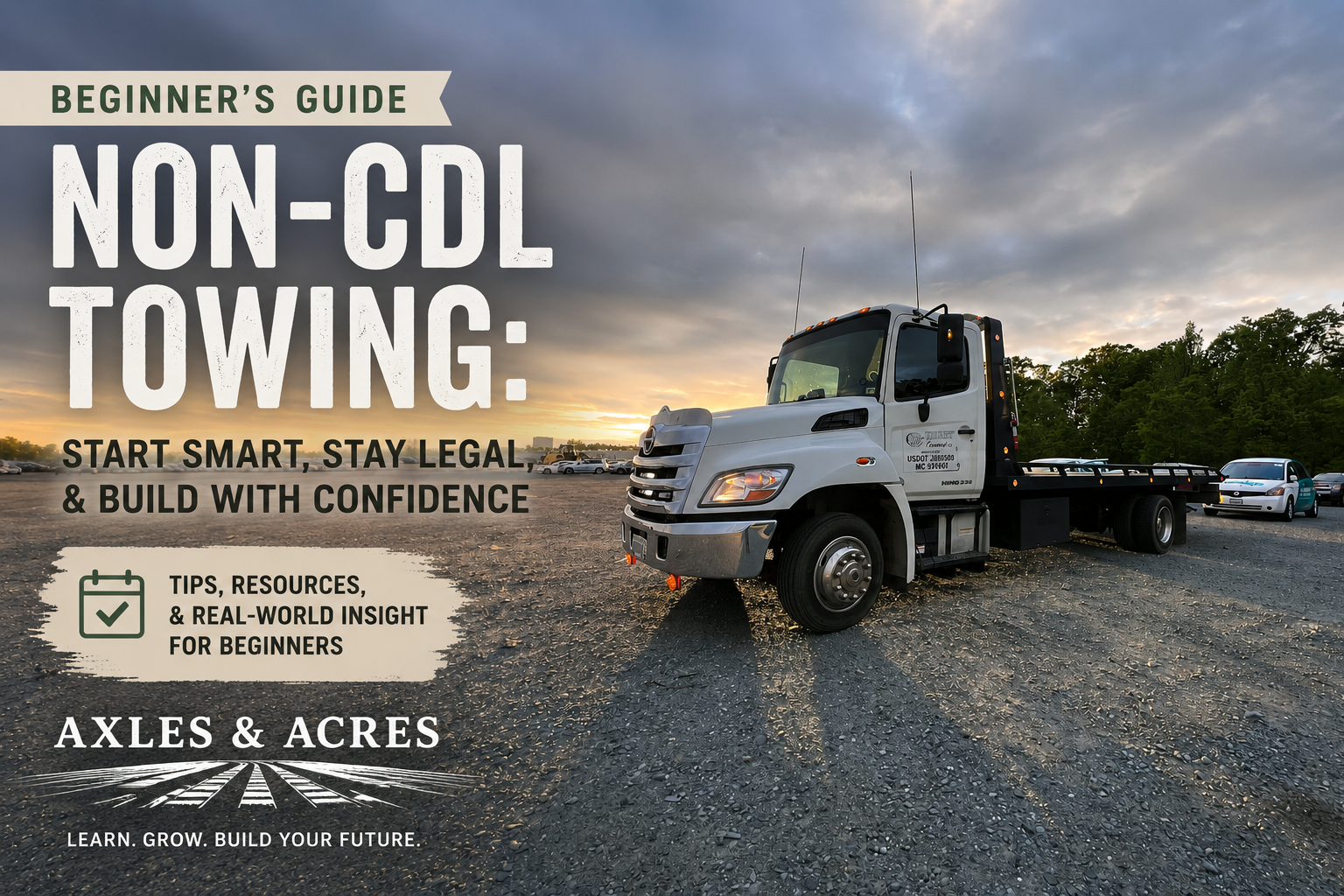
That's why we created the Beginner's Guide to Non-CDL Towing: Start Smart, Stay Legal & Build With Confidence.
We built it for the person who's sitting where we once sat:
Interested in the business. Looking at trucks. Trying to understand weight ratings. Wondering what equipment they'll need. Trying to make sense of DOT requirements. And hoping to avoid making an expensive mistake before they've even moved their first vehicle.
Inside, we go further into:
Truck and equipment considerations
Understanding weight ratings
Worksheets to help you evaluate configurations
DOT and safety equipment
Inspection checklists
Licensing and compliance resources
Startup considerations
Real-world lessons from the business we've actually built
It's the kind of resource I wish we'd had when we were trying to piece all of this together ourselves.
It doesn't replace FMCSA, your state agencies, your insurance company or professional advice.
It helps you understand what questions you should be asking and where you need to look for the answers.
→ EXPLORE THE BEGINNER'S GUIDE TO NON-CDL TOWING
Not Sure Which Resource You Need Yet?
That's okay too. We've put our towing and auto transport guides, free starter resources and business tools together on our Start & Build page.
That way you don't have to figure out which article or product comes next. You can start where you actually are.
Whether you're still researching your first truck, setting up the business, preparing for your first load or already trying to make the numbers work, that's the best place to see the full path in one place.
What I'd Tell the Beginner I Used to Be
I wouldn't tell her not to be nervous. I was nervous. I wouldn't tell her she needed to feel confident before she started. She didn't. I'd tell her to learn. Ask questions. Practice. Don't pretend to know something you don't. Respect the truck. Respect the weight. Respect the vehicle somebody has trusted you with. Learn the regulations. Build simple systems. Keep track of the money. And don't compare your first month to somebody else's twentieth year.
I came into this business from real estate without knowing how to back a truck and trailer. Wayne taught me. Then experience taught me. One trip taught me something. Then another and another.
Eventually the things I once worried about became part of an ordinary workday. That's how experience works.
You don't wait until you're confident and then begin. You begin carefully, and confidence grows from what you learn along the way.
So if you're standing at the beginning right now, you don't need to solve your entire future towing business today. Figure out the next thing you need to understand. Learn it well. Then take the next step. That's enough for today. 🌾
See you Along the Way.
Start & Build Your Towing Business
Beginner's Guide to Non-CDL Towing — Trucks, equipment, weight ratings, licensing resources, safety and preparing to get started.
Free Non-CDL Trip Inspection Sheet — Start building a simple inspection routine before your first load.
How to Find Work in Towing & Auto Transport — Our free in-depth article on where the work actually comes from.
From Setup to First Load — Finding work, carrier resources, auctions, dealers, business systems and preparing for your first loads.
Small Business Profit & Loss Statement — Start learning whether the work is actually making money.
Tow Equipment & Tools — Equipment and tools from the working side of our towing and auto transport business.
Start & Build — See all of our towing guides, free resources and business tools in one place.
This article shares our experience and general educational information. It is not legal, regulatory, insurance, tax or licensing advice. CDL, motor-carrier, towing and auto-transport requirements vary by vehicle, configuration, operation and jurisdiction and can change. Verify the current requirements that apply to your business with FMCSA, your state agencies, your insurer and other appropriate professionals before operating.
Disclosure: Some links may be affiliate links, which help support Axles & Acres at no additional cost to you. We only recommend products, tools and resources that have genuinely earned a place in our business and our lives—or, when clearly identified, products we've researched and believe may be useful. As an Amazon Associate, we earn from qualifying purchases.