
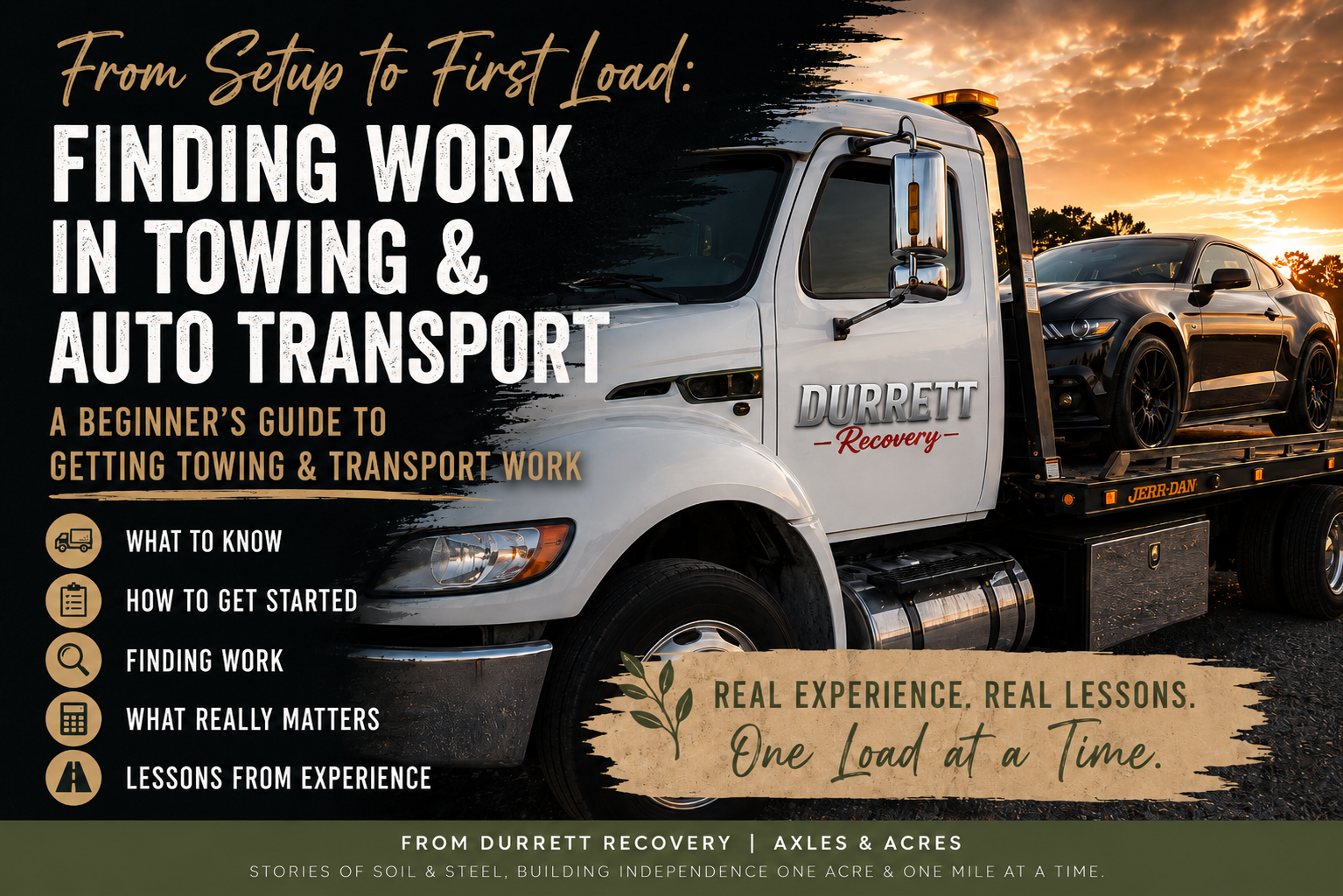
What we've learned about finding loads, building relationships and turning a truck into a real business
Buying the truck is one thing. Finding enough good work to build a business around it is another. When we bought our first truck, we thought one of the hardest parts was behind us. It wasn't. Once the truck was sitting there, a whole new set of questions showed up.
Where do we actually find work?
Who do we call? Which companies work with small carriers? Where are people finding these loads? What should we charge? How do we know whether a load is actually worth taking? What paperwork do we need? How do we turn one job into repeat work?
And maybe the biggest question:
How do you go from owning a truck to actually having a business?
We started Durrett Transport & Recovery in 2015, and since then we've moved thousands of vehicles. We've worked with auctions, dealers, brokers and customers, learned different systems, made mistakes, rebuilt parts of the business and figured out a lot of things one vehicle at a time.
We certainly don't know everything about this industry. But we know a lot more than we did when that first truck was sitting in the driveway. And if you're trying to figure out where the work comes from, I want to give you a real place to start.
Not just a list of company names. Because finding a load and building a business are two very different things.
First: Make Sure You're Actually Ready to Haul for Hire
I know this isn't the exciting answer when you're ready to start finding loads. But it matters.
Before signing up everywhere you can find, make sure you understand the requirements that apply to your particular operation. Those requirements aren't identical for every truck or every business.
Where you operate, whether you're interstate or intrastate, what you're hauling, your vehicle and weight ratings, and the type of work you're doing can all matter.
For interstate operations, the Federal Motor Carrier Safety Administration (FMCSA) is where I would start—not a random website offering to "handle your DOT number" for you. FMCSA explains that for-hire interstate motor carriers generally need operating authority in addition to a USDOT number when the operation is subject to those requirements.
If you're operating only within your state, don't assume that means there are no requirements. Here in Virginia, for example, the Virginia DMV Motor Carrier Services has separate information for, for-hire intrastate carriers. Virginia's requirements and exemptions depend on the type of operation and vehicle.
Use the official source for the state where you operate.
And don't let a Facebook comment, another driver's setup or even our setup be the final word on what your business needs.
Still figuring out the truck, equipment and setup?
That's exactly why we created our Beginner's Guide to Non-CDL Towing.
It covers the earlier part of the road: truck considerations, equipment, licensing and compliance questions to research, safety equipment and preparing to get started.
→ EXPLORE THE BEGINNER'S GUIDE TO NON-CDL TOWING
If you're already set up and asking, “Where do I find the work?”, keep going.
That's what the rest of this article is about.
Where Does Towing and Auto Transport Work Actually Come From?
One of the first things to understand is that there isn't one magical place where all the good loads live. Work can come from several directions:
Load boards and marketplaces.
Auto transport brokers and transportation companies.
Auctions.
Dealerships.
Fleet and commercial accounts.
Roadside networks, depending on your type of business.
Local businesses.
Direct customers.
And eventually, repeat customers and relationships.
Most businesses will end up with some combination of these. What that combination looks like depends on what kind of operation you're trying to build.
1. Load Boards Can Help You Find Work and Learn the Market
Load boards are one of the most obvious starting places for someone entering auto transport. They can help you see what's moving, where vehicles are going, what lanes stay active, what rates are being offered and which companies are posting work.
One of the largest names in vehicle transportation is Central Dispatch. Carriers can search available vehicles using criteria such as origin, destination, vehicle type, trailer type and minimum payment. Central Dispatch also provides shipper profiles and transaction ratings.
That last part matters.
Don't look only at the load. Look at who is offering it.
Before accepting work from a company you don't know, pay attention to the information available to you.
How does the rate compare with the miles and work involved? What are the pickup and delivery requirements? What are the payment terms? Does the company have a history with other carriers? Is there anything unusual about the vehicle? Is it operable? Are there storage deadlines or special pickup requirements? Does the load actually fit the route you're trying to build?
A load board can help put work on the truck.
But that doesn't mean every load on the board belongs on your truck.
2. Sign Up With Auto Transport Companies and Carrier Networks
Another place to look is directly at companies that maintain carrier networks. Some companies allow qualified carriers to complete an onboarding process and gain access to transportation opportunities through their system.
A few legitimate places worth researching include:
CarsArrive Network Carrier Onboarding — CarsArrive operates a vehicle transportation network connecting shippers and carriers and provides registered carriers access to available loads and route opportunities.
Ready Logistics Carrier Network — Ready Logistics works with qualified carriers and provides access to vehicle transportation opportunities through its network.
RunBuggy — RunBuggy provides app-based vehicle transportation opportunities and works with dealers, auctions, lenders and other automotive businesses.
These aren't recommendations that every company will be right for every carrier, and being approved doesn't guarantee work.
Think of them as places to research and doors you may be able to open.
Requirements, available work, rates and service areas change. Always review the company's current carrier requirements and agreement yourself before signing up or accepting work.
Want the organized version instead of hunting for all of this yourself?
This is one of the biggest reasons we created From Setup to First Load: A Beginner's Guide to Finding Work & Building Your Business.
I spent the time researching and organizing places to start looking for work, carrier and transportation company signup resources, auction opportunities, roadside options, business systems and the things I wish we'd understood before trying to piece all of this together ourselves.
→ EXPLORE FROM SETUP TO FIRST LOAD
The guide doesn't promise anybody a load or guarantee a company will approve you.
It gives you a much clearer map of where to look, what your options are and what to have ready when you get there.
3. Don't Overlook Auto Auctions
If you're hauling vehicles, start paying attention to the auctions around you. And don't think only about picking up one vehicle somebody bought online.
Auctions are part of a much larger vehicle ecosystem involving dealers, wholesalers, fleet companies, repossessions, insurance vehicles and transportation providers.
Manheim operates wholesale vehicle auction locations around the country. Individual Manheim location pages provide local transportation and gate information, and some locations have dedicated transporter assistance.
IAA also works with transporters. Its Tow App allows registered IAA transporters to manage and schedule vehicle pickups.
The important thing isn't just knowing that auctions exist.
Learn the auctions in the area you actually want to work.
Where are they? What days are busiest? What are their transporter procedures? What are their gate hours? How are vehicles released? What happens with inoperable vehicles? Is loading assistance available? Are there storage deadlines?
Those details can matter a lot more on a working Tuesday afternoon than knowing the name of fifty auctions you'll never visit. And once you're regularly around auctions, you're also around the people who buy and sell vehicles.
Which brings us to what has mattered even more in our own business.
4. Dealers Can Become Much More Than One Load
Dealer and auction transportation became one of the strongest parts of Durrett Recovery. And it taught us something we've never forgotten:
Relationships usually outlast load boards.
A load board can introduce you to work. A relationship can mean somebody calls you the next time they need a vehicle moved. That's a very different business.
Independent dealers, franchise dealers, wholesalers, repair facilities, body shops, rental operations and other automotive businesses may all have transportation needs.
You don't need a fancy sales presentation. Start by being professional. Introduce yourself. Explain what kind of transportation you provide. Be clear about your service area. Have your business information ready. And then, if somebody gives you an opportunity:
Show up. Communicate. Take care of the vehicle. Send the paperwork. Invoice correctly. Do what you said you were going to do.
We have built a lot more business from doing those simple things consistently than from trying to come up with some clever marketing trick.
People remember the carrier who makes their day easier. And they also remember the one who doesn't.
5. One Good Job Can Lead to the Next One
This is the part I don't think we understood enough when we started. When you're new, it's easy to think of work one load at a time.
Where's my next load?
That question matters in the beginning. But eventually a better question becomes:
How do I make this customer want to call us again?
If you pick up a vehicle from an auction for a dealer, that dealer may buy vehicles every week. If a broker learns that you communicate well and do what you say, they may remember you when another vehicle comes up on your lane. If an auction, dealership or business sees you regularly and gets to know your name, another door may open. If a customer trusts you with one vehicle, they may recommend you to someone else.
That's how one load starts becoming a business. Not every relationship will turn into repeat work. But some will. And those are worth taking care of.
6. Direct Customers Are Work Too
Not every vehicle has to come through a broker or load board. People need vehicles moved for all kinds of reasons. They buy a vehicle somewhere else. They sell one. They move. They have a vehicle that doesn't run. They need something delivered to a shop. A family member needs a vehicle moved. A business needs transportation. Someone buys a project car.
There are opportunities to build direct local business too. Your website, Google presence, business cards, referrals, local relationships and reputation can all become part of how customers find you. But direct work brings more responsibility too.
You're no longer simply accepting somebody else's dispatch. You're handling the customer relationship, scheduling, pricing, expectations, payment, documentation and problems yourself.
That's why learning the business side matters just as much as learning how to operate the truck.
Finding Work Is Only Half the Problem
This is where I want to save somebody from a mistake we made ourselves. When you're starting, getting a truck loaded feels like success. And it is progress.
But busy and profitable are not the same thing.
You can move vehicles all week and still discover that the numbers don't make sense. Fuel. Insurance. Maintenance. Repairs. Tires. Truck payments. Taxes. Tolls. Deadhead miles. Time spent waiting. Time spent loading. Time spent unloading. Administrative work. Equipment. Unexpected problems. These all come out of what the truck earns.
So before you accept a load simply because the rate sounds good, start learning to look at the whole job.
Where is the truck now? How far do you have to travel empty to get the vehicle? How far is the loaded trip? Where will the truck be after delivery? Can you find work coming back? How much time is the job likely to take? Are there tolls? Is the vehicle operable? Will loading it require extra work? Does the pickup or delivery schedule create a problem? When and how will you be paid?
A $500 load isn't automatically better than a $350 load. The route, time, expenses and what happens after delivery all matter.
Revenue is exciting. Profit pays the bills.
Know Whether the Truck Is Actually Making Money
This is exactly why I still believe in keeping the numbers simple enough that you'll actually look at them. I've used a basic Profit & Loss spreadsheet for years not only in this business, but back in my real estate career too.
You don't need a beautiful report that nobody opens. You need to be able to see:
What came in?
What went out?
And what's actually left?
If you're trying to get a clearer picture of the business behind the truck, we've made our Small Business Profit & Loss Statement available through Axles & Acres.
→ VIEW THE PROFIT & LOSS STATEMENT
It's a simple practical tool, but knowing your numbers can change the decisions you make about which work is actually worth taking.
The Truck Moves the Vehicle. The Systems Move the Business.
This is another thing nobody gets very excited about when buying a tow truck. Paperwork. Invoices. Scheduling. Customer information. Pickup details. Delivery details. Photos. Bills of lading. Receipts. Maintenance records. Expenses. Payment status. Follow-ups.
But once the work starts coming in, those things can become overwhelming very quickly if you don't have a system. You need to know:
What needs to be picked up?
When?
Where is it going?
Who is paying you?
What paperwork goes with it?
Has it been invoiced?
Have you been paid?
The exact system doesn't matter nearly as much as having one that you will consistently use. We share more of the spreadsheets, software and everyday systems we actually use on our Behind the Scenes page.
What We'd Do If We Were Starting Again
If I were standing beside that first truck again and asking where to find work, I wouldn't try to sign up with every company on the internet in one day.
I'd make sure the business was properly set up first.
I'd decide what kind of work we actually wanted to do.
I'd learn the auctions, dealers and automotive businesses around the area we wanted to serve.
I'd research a few legitimate load boards and carrier networks.
I'd get our paperwork organized.
I'd know our expenses well enough to recognize when a load didn't make sense.
I'd start making relationships.
And then I'd do the work well.
One load. Then another.
I'd pay attention to which customers were good to work with.
Which routes worked.
Which work paid well enough.
Which jobs created more problems than they were worth.
Which relationships led somewhere.
And I'd keep better track of all of it from the beginning. Because the lesson after all these years is still pretty simple:
A truck doesn't build a business.
A profitable system does.
What Equipment Do You Actually Need to Do the Work?
Once you start taking different kinds of vehicles, you also begin learning which equipment earns a permanent place on the truck.
We keep our towing and transport equipment recommendations separate because I don't want to turn an article about finding work into a shopping list.
But if you're building out your truck or trying to figure out what equipment might actually be useful, we've put our real-world recommendations in Tow Equipment & Tools.
That's where you'll find the straps, towing equipment, tools and other things we use or genuinely think are worth considering.
→ BROWSE TOW EQUIPMENT & TOOLS
Some equipment links may be affiliate links. When they are, we may earn a commission at no additional cost to you. We distinguish between equipment we personally use and products we've researched or recommend for a particular purpose.
From Setup to First Load
If you've read this far, you probably understand why I couldn't answer “Where do I find work?” with a list of five websites.
The websites are useful. The signup links are useful. But that's only one part of getting a new towing or auto transport business working.
You also need to understand the different places work comes from, how to prepare for opportunities, what companies may ask for, how to stay organized, how to think about rates and expenses, and how to start turning individual jobs into an actual business.
That's why we created From Setup to First Load: A Beginner's Guide to Finding Work & Building Your Business.
Inside, we've brought together the kind of information we wish we'd had in one place when we were starting:
Places to begin looking for towing and auto transport work
Broker, carrier and transportation-company signup resources
Dealer and auction opportunities
Roadside assistance opportunities for businesses that want that type of work
Application and preparation information
First-load checklists
Business systems and organization
Rates, expenses and profitability
Lessons we've learned from years of actually doing the work
This isn't a promise of loads. It isn't a shortcut around licensing, insurance, experience or hard work. And it isn't a list of companies we're claiming will approve every new carrier.
It's a roadmap.
We did the research and organized the options so someone starting today doesn't have to spend nearly as much time asking:
Where do I even begin?
→ EXPLORE FROM SETUP TO FIRST LOAD
Start With the Next Right Step
If you're brand new to this industry, it's easy to feel like you need to figure out everything at once. You don't. Figure out where you actually are and what you need help with next.
We've put our towing and auto transport guides, starter resources and business tools together on our Start & Build page so you can see what's available and choose the resource that fits where you are right now.
Or, if you already know what you need:
If you're still deciding on a truck, equipment and the basics of getting set up:
→ Beginner's Guide to Non-CDL Towing
If your truck and business are getting into place and now you're asking where to find work:
If you're already working and need to understand where the money is actually going:
→ Small Business Profit & Loss Statement
If you're building out the truck:
If you're trying to organize the business behind it:
And if you're looking for the larger collection of things we've learned, used and created:
You don't have to solve the entire business today. Learn the next thing you need to learn. Take care of the next thing that needs to be done. Then take the next load.
One Last Thing
When we first started, we thought success depended mostly on finding enough work. Now I think about it differently. Finding work matters. But being ready for the work matters too. Preparation helps you get started. Knowing your numbers helps you recognize good work. Systems help you handle it. Relationships create more opportunities. Your reputation follows you. And consistency gives all of it a chance to become something that lasts.
No single load, broker, customer, auction or load board builds a business by itself. You keep showing up. You learn who you work well with. You keep good records. You take care of the equipment. You communicate. You do what you said you would do. And little by little, load by load, the work starts becoming a business.
That's how it happened for us. And we're still learning. 🌾
See you Along the Way.
Keep Building
Beginner's Guide to Non-CDL Towing — Start with the truck, equipment, setup and questions worth understanding before you begin hauling.
From Setup to First Load — Find places to look for work, understand your options, get organized and prepare for your first loads.
Small Business Profit & Loss Statement — A simple way to see what's coming in, what's going out and what's actually left.
Tow Equipment & Tools — Equipment and tools from the real working side of towing and auto transport.
Behind the Scenes — The spreadsheets, systems, software and workflows that help us keep Durrett Recovery and Axles & Acres moving.
Helpful Resources — Our larger collection of guides, tools, equipment, software and other resources we've found useful along the way.
Information here is based on our own experience and is intended as a practical starting point, not legal, licensing, insurance, tax or regulatory advice. Requirements vary by operation and location and can change. Verify current requirements with FMCSA, your state agencies, your insurer and other appropriate professionals before operating.
Disclosure: Some links may be affiliate links, which help support Axles & Acres at no additional cost to you. We only recommend products, tools and resources that have genuinely earned a place in our business and our lives—or, when clearly identified, products we've researched and believe may be useful. As an Amazon Associate, we earn from qualifying purchases.


